 |
|
|
 |
DOGS
TODAY October 2003
|
|
 |
Peter
Neville's TRUE CASE HISTORIES |
|
 |
|
|
|
|
|
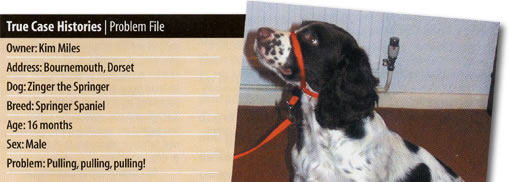 |
When
it comes to canine behaviour and training problems, the most
common is pulling on the lead! Despite all the aggression problems, separation-related disorders, and phobias and nervousness difficulties that fill a behaviourist’s day, it’s pulling and lead control that vexes most owners, it seems |
|
|
 |
|
||
 |
You’d
think that pulling would be simple enough for owners to treat and
that a behaviour referral wouldn’t be necessary. That is
until, as a dog owner, you actually try to stop a dog from getting
wherever he wants to go at top speed. He’ll pull your arm
out of its socket and strangle himself until his eyes bulge! Indeed, it used to be that not all behaviourists or trainers could offer too much in the way of a solution to this stressful practical problem, and, as a result, many dogs simply carried on strangling themselves all the way to the park. |
|
|
Consequently, they got far fewer walks than they needed because it was just too much of an ordeal for their owners to take them out. Other dogs were cruelly treated using confrontation and abuse by some so-called ‘trainers’. It is surely a testament to the incompetence of man that so many barbaric implements have been — and sadly still are — used to tackle this common problem, from horrible choke chains and prong collars, to electric shock collars and even beating the poor dog into submission.
Of course, as every good trainer and behaviourist can tell you, it is far better to prevent a problem from developing in a young dog than having to treat it later in an adult. So it’s great that there are now so many puppy classes around that are placing a strong emphasis on teaching puppies to walk in a relaxed manner on the lead using happy, positive reinforcement — initially just for walking on a loose lead next to their owner. The puppy never expects to walk in any other way, because it’s simply more fun to walk where the rewards appear.
As every training book will tell you, dogs pull on the lead for different reasons: enthusiasm to get to the park, following a scent on the ground, wanting to lead their owner into new places, insecurity and wanting to get to known places of safety as fast as possible... Some pull simply because they have something to pull against —pressure on the collar invites counterpressure, and the whole thing descends into a battle of strength, for no other reason than the dog is on a lead in the first place.
A good trainer keeps a pack of ideas, techniques and equipment for teaching lead-training, from which the most appropriate method is selected. But that’s only once the owner has gone to a good trainer for help! Many owners never make it that far. Some simply endure the problem, hang on for grim death, or just get rid of the dog, often only to repeat all of the problems with their next pet, of course.
| As
if by magic... What we got when we fitted the Gentle Leader to Zinger was one of those occasional instant total transformations that happens with some dogs when they feel its effects. He simply stopped pulling on the lead and calmed down! He sat or stood and remained attentive to Kim and alert to all that was going on around him. He didn’t try to get anywhere unless she led him, at which point he just trotted along beside her as if he had never pulled in his life! |
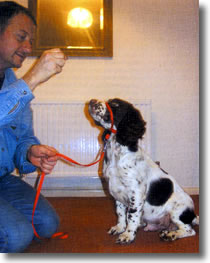 |
| Now; I would be the first to say that this was rather unusual, as most dogs take a few minutes to get used to wearing the Gentle Leader, and some try to paw it off their face for a while before they settle down. In fact, I always make a point of advising owners to expect some protest; it is often the case that the more a dog struggles initially, the better he accepts it in the end. But Zinger, bless him, seemed to treat wearing the Gentle Leader as just another thing in life’s range of experiences. Now, he was viewing life differently and with Kim, rather than in spite of her. | |
| Needless to say, Kim was delighted that her dog was no longer panting and struggling, and she stayed for the training class with Jo and several other dogs, including a well-behaved Labrador friend, who Zinger had often played with in very high spirits. Now, the two of them happily lined up to do their sit-stays and all the other stuff, with not a single thought of being disruptive. |
It had all seemed so easy almost embarrassingly so. Jo and I wondered, as we often do, which madman it was that first expected dogs to be walked and trained with a neckcollar, rather than with a headcollar when it works so well with many other strong animals! Whoever it was sure made life difficult ever since for just about every dog trainer and owner!
 By
virtue of the nose-loop encircling his muzzle, the Gentle Leader controlled
and steered Zinger’s head in the same way as any other headcollar
does with horses, bulls, goats, camels etc. This gives a far better degree
of control, and requires virtually no force, compared with attempting
to lead, walk or train a dog via a leash and neckcollar.
By
virtue of the nose-loop encircling his muzzle, the Gentle Leader controlled
and steered Zinger’s head in the same way as any other headcollar
does with horses, bulls, goats, camels etc. This gives a far better degree
of control, and requires virtually no force, compared with attempting
to lead, walk or train a dog via a leash and neckcollar. The
pressure around the muzzle caused by the adjusted snug fit of the nose-loop
of the headcollar also probably had a natural canine psychological effect
on Zinger, as it does on most dogs who wear one. It causes a typical
relaxation response in the same way as when wolves and dogs may gently
grasp the muzzle of younger packmates, or when subordinates present their
muzzle to be held by an older or parent figure in the pack. The nose-loop
is also believed to impact on acupressure points on a dog’s face,
stimulating a natural relaxation response.
The
pressure around the muzzle caused by the adjusted snug fit of the nose-loop
of the headcollar also probably had a natural canine psychological effect
on Zinger, as it does on most dogs who wear one. It causes a typical
relaxation response in the same way as when wolves and dogs may gently
grasp the muzzle of younger packmates, or when subordinates present their
muzzle to be held by an older or parent figure in the pack. The nose-loop
is also believed to impact on acupressure points on a dog’s face,
stimulating a natural relaxation response. The
special double D-ring of the Gentle Leader, positioned carefully above
Zinger’s Adam’s apple, painlessly transferred some of the
tension to the back of his neck when he tried to pull on the lead. This
stimulated a second natural relaxation response, one that begins in puppyhood — a
puppy relaxes automatically if his mother (or a person) picks him up
by the scruff of the neck so that he may be carried quickly and efficiently
without any struggle, perhaps away from danger. This innate response
continues to some degree in most adult dogs, as it did with Zinger, and
further helped to calm him down.
The
special double D-ring of the Gentle Leader, positioned carefully above
Zinger’s Adam’s apple, painlessly transferred some of the
tension to the back of his neck when he tried to pull on the lead. This
stimulated a second natural relaxation response, one that begins in puppyhood — a
puppy relaxes automatically if his mother (or a person) picks him up
by the scruff of the neck so that he may be carried quickly and efficiently
without any struggle, perhaps away from danger. This innate response
continues to some degree in most adult dogs, as it did with Zinger, and
further helped to calm him down.
|
Award-winning The Gentle Leader’s astonishing impact on dogs like Zinger has caught the attention not only of the world’s top vets and trainers, but also the scientific community! It has just been included in the world’s top 100 inventions selected by the prestigious Smithsonian Institute in the USA, and so it is now independently seen as one of the most useful of consumer products ever made! It is listed alongside the Hoover, Velcro and all those other marvelous inventions that make modem life easier — not bad for an item invented specifically for dogs and their owners. |
|||
| Largely as a result of this, the Gentle Leader was recently featured in the New York Times, a publication certainly not noted for frivolous reporting. Quite apart from the impact through trainers and pet shops, direct sales by the manufacturers in the month following exceeded 10,000 as a result of this one article! | ||||
| Sales in the USA alone have now gone well past a staggering one million, with huge numbers also sold in the UK, the rest of Europe, Australia and Japan. The inventors, Veterinary Professor Emeritus Bob Anderson and Ruth Foster a former head of the National Association of Obedience Instructors of the USA, were honoured by a special presentation and reception to commemorate their invention last autumn in the USA. | ||||
| Their idea has resulted in an awful lot of contented dogs and delighted owners around the world, and also an enormous number of satisfied trainers, behaviourists and veterinarians, who now recommend the Gentle Leader simply because it makes their jobs so much easier in so many cases. |

For owners seeking help with the behaviour and training of their puppies and dogs, a Gentle Leader trainers’ list has been established, initially for the UK and Ireland, though it is now being extended to cover other European countries.