 |
|
|
 |
DOGS
TODAY May 1996
|
|
 |
Peter
Neville's TRUE CASE HISTORIES |
|
 |
|
 Dear
Peter,
Dear
Peter,
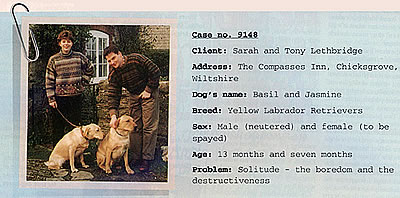
All summer, we enjoy having people bring their dogs to the Compasses where everyone can sit in the gardens.
While we would love to have our dogs inside the pub, we don't have enough space. It's a narrow, cosy half-lit bar and we have to exclude our dogs for fear of all our customers bringing their own dogs in, especially during the colder weather.
Unfortunately, this has meant our dogs have to be left upstairs during opening hours. As a puppy, Basil, our older dog, had quite a few problems being left upstairs. His occasional chewing and whining (clearly audible in the pub) told us he wasn't happy about being alone, especially as he is such a sociable, friendly dog.
This was one of the reasons we bought Jasmine last year - to provide canine company. Despite the, whenever we leave Basil upstairs he seems to become very anxious and destructive. We're not sure whether he's upset or just bored at the prospect of nothing to do. We would welcome your ideas on how to keep him stimulated during opening hours - especially as Jasmine is starting to copy him!
Yours sincerely,
Sarah & Tony Lethbridge
Readers who are lucky enough to have the very first issue of Dogs Today will remember the True Case History of two Labradors, Bruno and Tyson, at my local thatched pub, The Compasses. In his boredom, Bruno had taken to chewing boxes of matches and had nearly set the place alight with a box of Swan Vestas! Bruno has moved on now with the former landlords, and, sadly, Tyson was shot by a trigger-happy farmer, but, after a long period of closure, there are new landlords at The Compasses and the happy old doggie days have returned. Two new Labradors are resident at the pub. The reason there are two is because Basil, the first dog, also had problems adjusting to periods of being on his own during opening hours.
The arrival of Jasmine helped, but in many respects, poor Sarah and Tony doubled their problems. Suddenly, there were two dogs chewing, two dogs pacing up and down and two dogs whining for some action, despite the longest of daily walks through nearby woods. No wonder Sarah and Tony ordered in Hooch alcoholic lemonade instead of the Two Dogs brand! Basil started to show the classic signs of separation anxiety, a common problem in young dogs. A dog often demonstrates his worry at being left alone by barking and howling to attract his owners back. He may also destroy furniture to work off the adrenalin produced when dogs get upset or excited. In very severe cases, dogs can lose bowel and bladder control. They may pace in a stereotypical pattern, wearing a circle out on the carpet, or even start to mutilate themselves by chewing at their feet. Some can become aggressive, but things are not usually quite so bad in puppies and young dogs.
DEPENDENT
DOGS
A dog's anxiety when left alone is fully understandable; after all, dogs
have evolved to live in small packs as a survival mechanism, so it isn't
natural for them to be alone. Most dogs learn to cope as puppies through
early experiences of solitude, though some, especially Labradors like
Basil, may take some time to learn to relax and stop being destructive
when alone. The problem is always compounded in cases where the dog ordinarily
spends a lot of time in the company of its owners and is rarely left alone,
especially of course, if the dog sleeps in the owner's bedroom. Treatment
for separation anxiety can involve major adjustments to owner-dog relations
and it can take some time, and even drug therapy, to help them cope alone.
Fortunately, with the problems being addressed before they reached crisis
point, treatment for Basil was more a matter of common-sense.
LOCK
IN
After a slurred, late-night discussion at the bar (me, not they!), Sarah
and Tony agreed not to allow Basil or Jasmine to follow them around too
much upstairs, and to be rather off-hand whenever the dogs tried to demand
attention. This never means less attention for the over-attached dog,
merely that he must wait to be invited before being fussed. A dog's relationship
with the owner should be at the owner's initiation rather than being at
the whim of the dog. Otherwise, the dog becomes less able to live without
direct company and physical contact. Small adjustments, carried out over
a couple weeks, help redefine the social order and decrease the over attachment
that lies at the root of the separation problem.
I
also asked Sarah and Tony to switch off any form of contact for Basil
and Jasmine for 10-15 minutes before they went down to open the bar and
not to pause to say goodbye as they left, as this would simply heighten
the dogs' expectations of being able to keep them at home. Sarah and Tony
were asked to feed and exercise the dogs before that switch-off period
and settle them on their beanbags by the radiator, with the radio playing
gently. All this was more precautionary than anything else. The main problem
wasn't so much separation anxiety as boredom in a very lively, active
pair of young dogs. Playful, active dogs need a constant flow of stimulation
and activity, both mental and physical, and can't always be expected to
sleep like babies (where did that expression come from? My babies don't
sleep)! Basil and Jasmine needed something to keep them occupied when
left alone and it was with great delight that I was able to try out a
fabulous new toy from Denmark called the Cube.
 CANINE
CUBISM
CANINE
CUBISM
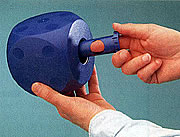
The Cube is a large, tough, washable, blue plastic cube, marked like dice
with the 'one' face concealing its true action. By inserting a finger
into the hole, a tube can be pulled out in which to place a good supply
of dry food nuggets or tasty dry treats. Replace the tube, roll the cube
around a little to distribute the food throughout the internal chambers
and you have a wonderful feeder toy ready for your dog to play with. As
he noses or paws it around (it's too big and tough to chew) the treats
drop out a couple at a time, though you can adjust the rate by turning
the internal tube. It's the perfect occupational therapy for the home-alone
dog because once he's worked out how to get the food to appear, he's hooked.
Most dogs pick it up after a short demonstration, but the ever-hungry
Labradors learn very quickly indeed!
The
Cube appeals to dogs' basic foraging instincts and keeps them actively
playing for as long as they are interested - which is usually until it
is empty and doesn't rattle when rolled or pushed. Even little dogs benefit
from it because it is light enough for them to nose and paw around; in
fact, dexterity is more important than strength when it comes to Cube-play.
It really did work wonders for Basil and Jasmine, who are now given their
Cubes as Sarah and Tony go downstairs to open the bar. There's not so
much as a sorrowful glance anymore, no whines and no destructiveness;
in fact, Basil and Jasmine look positively delighted at the prospect of
being given their Cubes and can't wait for opening hours! The only thing
Sarah and Tony have to remember is to subtract the food that went into
the Cube from their dogs' daily rations or they could end up with two
rather tubby Labs.
A
SQUARE MEAL
Other owners should also be careful to give each dog his own Cube, perhaps
in a separate room, if their dogs are inclined to be possessive over food.
Some dogs play with the Cube so intently that it has to be taken away
from them after a while if they are not to exhaust themselves completely!
. For the family dog, the Cube is worth every penny if you've got a bored
or destructive dog, or just want to keep him occupied and happy when you're
away. With some clients, who came seeking help with serious dog problems,
my COAPE colleagues have found that the Cube is all that's needed to overcome
separation anxieties and boredom, so maybe the Cube marks the end of the
need to consult pet shrinks for a lot of these problems. Oh well, never
mind, I'll just have to spend more time at my favourite pub!